


The scale of the problem most people don’t see
The construction, demolition and excavation sector accounts for 62 per cent of all UK waste (DEFRA, 2018). An estimated 40 per cent of all plastic generated on a construction site ends up in landfill. The UK as a whole sends 350,000 tonnes of textiles to landfill every year.
PPE sits awkwardly in the middle of all of that. It’s mostly plastic. It’s usually contaminated with site materials. It’s often branded. And it’s frequently safety-certified, which creates a problem that very few “recycling” conversations address: a hard hat that has reached the end of its certified service life isn’t junk — it’s a liability if it ends up back on someone’s head.
Add to that a landfill tax rising at around 20 per cent a year and a steadily shrinking number of available sites, and the cost of doing nothing is no longer just reputational. It’s commercial.
What “recycled” usually means — and why that matters
There’s a real difference between collecting PPE and responsibly ending its working life. A lot of what’s described as “PPE recycling” in our sector still involves whole-garment export — better items routed to other parts of the world. From a waste reporting perspective, that route is hard to evidence. From a brand protection perspective, it’s harder still: there’s no guarantee a branded hi-vis won’t reappear somewhere it shouldn’t. And from a safety perspective, items with expired certifications can re-enter use.
That’s the test any “closed-loop” claim needs to pass. Three questions:
- Where does the material physically go, and can that be evidenced?
- Are certified-use items (hard hats, harnesses, footwear) prevented from re-entering service?
- What does the reporting actually look like — a waste transfer note, or auditable end-of-life data?
Secure destruction as the starting point, not the afterthought
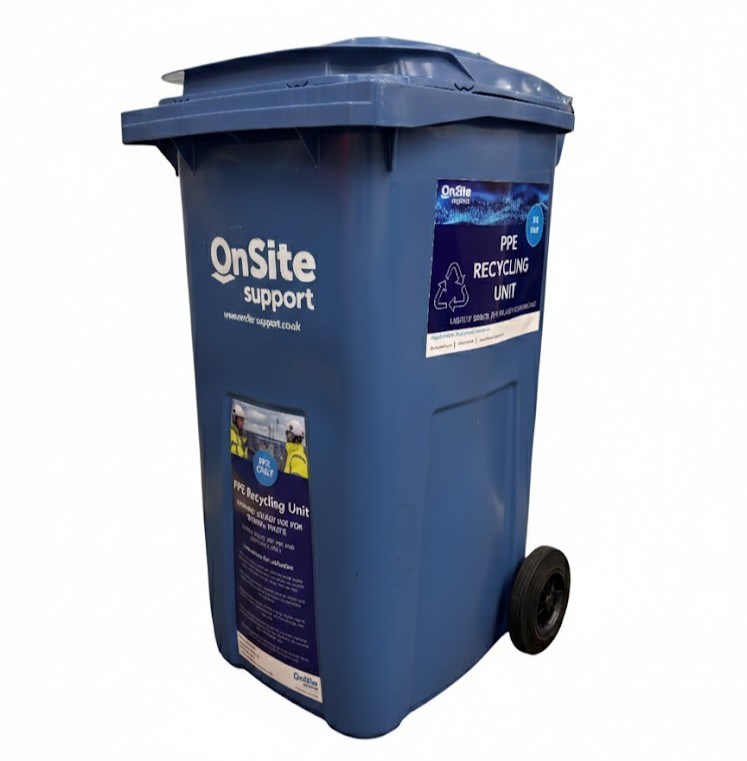
Our PPE and packaging recycling service is delivered in partnership with a specialist secure destruction and recycling partner.
That ordering matters. They operate as a secure destruction provider first — meaning every item collected is destroyed so it cannot be re-worn or re-used. Nothing is resold. Nothing is redistributed. For items with a defined service life or certification period — hard hats being the obvious example — that’s not an over-engineered solution. It’s the only responsible one.
Most clients don’t need to think about any of this in practice. There’s no segregation by item type, no sorting hard hats from gloves or garments from boots. Everything goes into the secure sacks provided, into the secure bins on site. Where we deliver, our FORS Gold fleet collects on the backhaul — no additional vehicle movements, fully traceable from site level. Outside that area, a third-party provider arranges collection.
Where the material actually ends up
Once collected, all material is processed through certified secure destruction.
Textiles and garments are shredded and processed into fibre for industrial end uses.
Non-clothing items — hard hats, gloves, footwear — are currently routed through Energy from Waste (EfW) or Solid Recovered Fuel (SRF) repurposing.
Energy from Waste isn’t the ideal destination. We’re not going to pretend otherwise. Material recovery sits higher on the waste hierarchy than energy recovery, and that’s where the sector needs to keep pushing. But EfW and SRF are regulated, recognised routes — and significantly better than landfill. The result: 100 per cent landfill diversion across every material we collect.
Why this matters for your ESG reports
Investors, regulators and contractors are increasingly asking what happens to operational waste — including PPE — and how that data is captured. Legislation such as the Landfill Directive and the Modern Slavery Act shapes some of those questions; ESG disclosure frameworks and stakeholder scrutiny shape the rest. Being able to evidence what physically happens to your end-of-life PPE is no longer a nice-to-have — it’s part of the sustainability reporting that has to stand up to external scrutiny.
Clients on our recycling service receive weight tickets and a Certificate of Destruction and Recycling for every collection. But the reporting goes further than that: a Power BI-style web-based platform that identifies waste streams and provides fully auditable end-of-life data — not just a waste transfer note. For anyone evidencing sustainability progress, or building an ESG report that has to stand up to scrutiny, that’s the documented, traceable output the question is actually asking for.
Where PLUS fits in
PLUS, our in-house data analytics and procurement platform, is where end-of-life sits alongside everything else: PPE spend visibility, compliance tracking, emissions and embodied-carbon reporting reviewed in quarterly business reviews. The waste stream reporting from the recycling service feeds in monthly. The point isn’t that any one of these things is impressive on its own — it’s that they become genuinely useful when they sit in one place rather than five separate ones.
For clients building a sustainability picture rather than just a sustainability claim, that joined-up view is what “good” looks like in 2026.